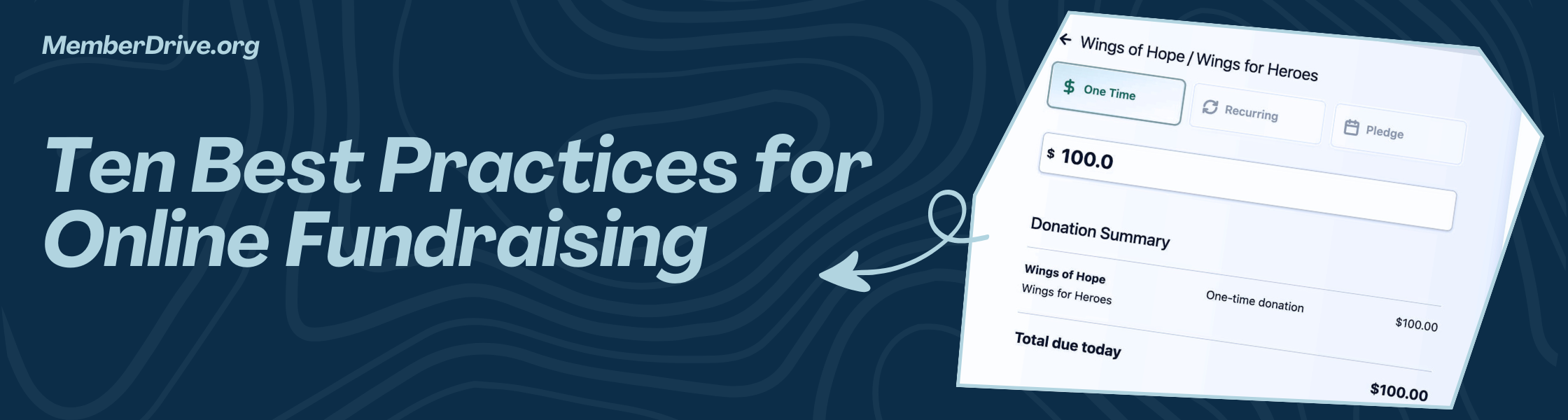
Ten Best Practices for Online Fundraising
The average online donation is $128 — but most organizations only capture a fraction of their potential because their campaigns rely on hope rather than strategy.
Online fundraising isn't about having the biggest audience or the slickest video. It's about understanding how people actually behave when they're deciding whether to give. The donors who click Donate Now
aren't just responding to a need. They're responding to clarity, trust, and a story they can see themselves in.
These ten practices are drawn from organizations that consistently outperform their fundraising goals. None require a massive budget. All require intention.
1. Set a Goal People Can Understand in One Sentence
Help us fight hunger
is a mission. We need $25,000 to provide 500 meals to families this month
is a goal donors can act on.
When supporters understand exactly what their money accomplishes, two things happen: they give more, and they tell others. A clear target removes the vague anxiety of will this actually help?
and replaces it with the satisfaction of hitting a milestone.
Make it work: - Attach a number to every campaign: dollars, people served, meals delivered, animals rescued - Break the big goal into visible milestones — $5,000 funded the kitchen renovation, $10,000 stocks the pantry - Show progress in real time with a visual indicator donors can check - Explain what happens if you exceed the goal — donors love knowing their extra $20 still matters
Before: Help support our after-school program
After: We're raising $15,000 to give 40 kids a safe place to learn, create, and eat a real dinner — five days a week, all year long.
2. Lead With a Story, Not a Statistic
Data convinces the head. Stories convince the heart — and the heart writes the check.
When researchers study why people donate, the consistent answer isn't logic. It's connection. A single person with a name and a specific challenge will outperform a paragraph about systemic issues every time. That doesn't mean your cause isn't serious. It means humans aren't wired to feel urgency about abstractions.
Make it work: - Start with one person, one moment, one specific challenge - Use the person's own words when possible — direct quotes create instant intimacy - Show the before (the struggle), the during (your organization's role), and the after (the outcome donors make possible) - Pair the story with one photo that captures emotion, not just activity - Keep the narrative to two or three paragraphs; the goal is resonance, not a biography
What works:
Every Tuesday at 4 p.m., Marcus walks into our center and doesn't say a word for twenty minutes. He just sits. Then he picks up a guitar — one we bought with last spring's campaign — and plays for an hour. Your donation doesn't just fund instruments. It funds the first place Marcus has felt safe enough to make noise.
3. Remove Every Friction Point Between Interest and Action
For every extra field in your donation form, completion rates drop. For every extra click, more people leave. The organizations that raise the most aren't necessarily the most compelling — they're the easiest to give to.
A potential donor who has decided to give is in a generous, trusting state. A clunky form, a surprise account creation requirement, or a page that loads slowly on mobile kills that momentum. The best donation experience feels almost too easy.
Make it work: - Limit your form to the essentials: amount, name, email, payment info - Let donors choose their own amount — preset buttons plus a custom field - Enable one-time giving without forcing account creation - Optimize for mobile first; over half of online donations happen on phones - Test the full flow yourself monthly on different devices - Make the confirmation page instant and warm — not just a receipt, but a thank-you that reinforces the impact
4. Give Supporters a Clear Next Step — Everywhere
Most visitors to your donation page won't give on their first visit. The difference between organizations that convert and those that don't is often one thing: a visible, specific request to act.
Support our cause
is vague. Donate $25 to feed a family for a week
is a decision someone can make in three seconds. Your call to action should remove all ambiguity about what happens when someone clicks.
Make it work:
- Use verbs that describe the outcome: Send Meals,
Sponsor a Student,
Fund a Rescue
- Place your primary CTA above the fold on every campaign page
- Repeat the CTA after your story, not just at the top — emotion drives action, but people need the button where the feeling is strongest
- Test button language; Give Now
and Donate Today
often perform differently depending on your audience
- Make the button visually impossible to miss — contrast, size, and white space all matter
5. Turn Donors Into Advocates
Your average supporter knows 150 people. If even five of them share your campaign, your reach multiplies without you spending a dollar on ads.
Peer-to-peer fundraising isn't a nice bonus — it's one of the most effective channels available. People give to people they know. A recommendation from a friend is more persuasive than any marketing copy you could write.
Make it work: - Create simple fundraising pages supporters can personalize with their own story - Provide a toolkit: graphics, sample posts, email templates, talking points - Celebrate your fundraisers publicly — recognition is often more motivating than prizes - Set up team challenges that let groups compete toward a shared goal - Make sharing effortless with pre-written social posts that supporters can publish in one click
Example structure:
Join our 50 Heroes campaign. Each hero raises $500 by inviting 10 friends to give $50. Together, we fund an entire semester of tutoring for 30 students.
6. Follow Up Like the Relationship Matters — Because It Does
The thank-you is not the end of the transaction. It's the beginning of the relationship.
Donors who receive a timely, meaningful acknowledgment give again at nearly double the rate of those who don't. And yet, organizations routinely treat the confirmation email as an afterthought — or worse, they don't follow up at all beyond the receipt.
Make it work:
- Send an immediate confirmation that feels human, not automated
- Within 48 hours, send a personal thank-you that references the specific campaign and expected impact
- Share progress updates as milestones are hit — You helped us reach 50% of our goal
- After the campaign, report the final outcome with specific results: Together we raised $34,000 and placed 27 dogs in forever homes
- Ask for feedback on the donation experience — it shows you care about their experience, not just their money
The 30-day rule: Every donor should hear from you again within a month of giving, even if it's just a quick update. Silence trains people to forget you.
7. Make Promotion Effortless for Your Community
Your supporters want to help. Most of them just don't know what to say.
When someone shares your campaign, they're putting their own credibility on the line. The easier you make it to share something that sounds authentic and informed, the more people will do it.
Make it work:
- Design square and story-sized graphics supporters can post without editing
- Write social copy in the first person so supporters can post it as their own: I'm raising money for...
- Create a campaign hashtag that's specific and easy to remember — #SaveTheArctic2026 beats #Charity
- Provide email templates for different audiences: close friends, coworkers, extended network
- Include share buttons at the exact moment donors feel best — the confirmation page right after they give
8. Meet Donors Where They Pay
The payment method someone prefers is usually the one they'll actually use. Make them hunt for it, and a percentage will simply leave.
This isn't about offering every option under the sun. It's about covering the methods your specific audience already trusts. A Gen Z donor and a corporate foundation director have very different expectations.
Make it work: - Accept all major credit cards — this is baseline, not optional - Offer digital wallets (Apple Pay, Google Pay) for mobile donors — they reduce checkout friction significantly - Include ACH bank transfers for larger gifts; some donors prefer this for tax record purposes - Ensure your payment flow is mobile-optimized and secure-looking — trust indicators matter - Display security badges and clear privacy language near the payment fields
9. Design for Recurring Revenue, Not Just One-Time Gifts
A donor who gives $25 once is generous. A donor who gives $25 monthly is transformative. Recurring donors have a lifetime value 5–10x higher than one-time givers, and they create the predictable cash flow that lets you plan ahead instead of constantly campaigning.
The key is framing monthly giving as a specific, tangible commitment — not just a checkbox at checkout.
Make it work:
- Show the math: $25/month = one family's groceries every week
- Name your recurring program — The Sustainer Circle,
Monthly Champions
— so donors feel like members, not transactions
- Give recurring donors something exclusive: early updates, behind-the-scenes content, direct replies from your team
- Make it easy to modify or pause, not just cancel — flexibility reduces anxiety about commitment
- Highlight recurring options prominently, not buried in fine print
Example framing:
Become a monthly supporter. For less than a streaming subscription, you ensure a child has tutoring, meals, and mentorship — every single month.
10. Know Your Donors Better Than Your Competitors Do
You can't build loyalty with people you don't understand. The organizations that retain donors year after year treat their supporter list as a community to be cultivated, not a mailing list to be blasted.
A simple CRM lets you track who gave, when, how much, and what they responded to. That data turns generic campaigns into personal conversations.
Make it work:
- Record every interaction: donations, event attendance, volunteer hours, email opens
- Segment your list by behavior, not just donation size — a first-time $20 donor needs a different message than a repeat $500 donor
- Use your data to time your asks; someone who gave last November probably doesn't want a July appeal
- Track which campaigns and messages each donor responded to, then refine
- Personalize subject lines and greetings — Hi Sarah, you helped us reach our spring goal
outperforms Dear Supporter
every time
How These Practices Work Together
No single tactic on this list will transform your fundraising. The power is in the system.
A compelling story brings someone to your page. A clear goal and frictionless form convert that interest into a donation. Prompt follow-up and smart promotion turn that donor into an advocate. Recurring options and relationship tracking turn that advocate into a long-term partner.
Start with the foundation — clarity in your goal and authenticity in your story. Then layer in the mechanics: simpler forms, stronger CTAs, easier sharing. Finally, build the infrastructure that sustains growth: recurring programs, advocacy tools, and a CRM that helps you treat every donor like the relationship matters.
The organizations that master this system don't just raise more money. They build communities that sustain their mission for years.
Your Next Step
Pick one practice from this list — just one — and implement it on your next campaign. Test the change. Measure the difference. Then add another.
Fundraising isn't about perfection on day one. It's about continuous improvement driven by attention to the donor's experience.
If you're ready to put these practices into action with tools built specifically for membership fundraising, MemberDrive can help you streamline donations, manage recurring giving, and build lasting donor relationships — all in one place.
Need help implementing any of these best practices? Our team is here to support your fundraising success. Reach out to us at support@memberdrive.org to learn how MemberDrive can help you optimize your online fundraising campaigns.