Understanding Matching Gifts
How One Major Donor Can Multiply Your Campaign's Impact
Matching gifts are one of the most effective fundraising strategies available to nonprofits, schools, and mission-driven organizations. They take a single major gift and transform it into a campaign-wide catalyst that motivates other donors, creates urgency, and multiplies every dollar that comes in. When a lead donor commits to matching contributions, suddenly a $100 gift becomes $200, or $300, or even $400 in total impact.
Picture this: a major donor approaches your organization with an offer. I'll match every dollar donated to your campaign, up to $10,000.
Without the right tools, you'd be stuck tracking spreadsheets, sending manual updates, and hoping you don't lose track of who matched what. The administrative burden alone might make you hesitate.
This is where matching gifts come in—and why having them built directly into your fundraising platform changes everything.
This article explores how matching gifts work, why they're so effective, and how modern fundraising platforms have made them easier to run than ever before.
What Are Matching Gifts?
A matching gift is a commitment by a lead donor to match donations from other supporters at a specific ratio, up to a maximum amount, within a defined time period.
Think of it as a fundraising amplifier. Instead of asking a major donor to simply write a large check, you invite them to leverage their gift to inspire others. The lead donor sets the terms: the match ratio (how many dollars they'll contribute for every dollar donated), the maximum total commitment, and optionally, the time window during which the match applies.
For example: I'll match every dollar donated 2x, up to $5,000, through August 31st.
This simple commitment creates a powerful dynamic. Every $100 donation during the match period doesn't just bring in $100—it brings in $300 total ($100 from the donor plus $200 from the lead donor's match). The multiplier effect is immediate and visible.
It's important to distinguish this type of matching gift from corporate matching programs. Corporate matching is typically initiated by individual donors who work for companies with philanthropy programs—the donor submits their gift to their employer, who then matches it according to company policy. The matching gifts we're discussing here are donor-initiated: a lead donor proactively commits to matching other donors' contributions to a specific campaign.
The Impact Multiplier Explained
Matching gifts operate on a ratio system that determines how much the lead donor contributes for each dollar donated by others.
A 1:1 match (also called dollar-for-dollar
) doubles the impact of each gift. A $50 donation becomes $100 total. This is the most common match ratio and works well for most campaigns because it's easy for donors to understand: their gift is worth twice as much.
A 2:1 match triples the impact. For every dollar donated, the lead donor contributes two. That same $50 donation now generates $150 in total impact. The psychological effect here is powerful—donors see their contribution going three times as far.
A 3:1 match quadruples the impact. A $50 donation becomes $200 total. Higher multipliers like this create exceptional urgency and can drive significant participation, though they require lead donors with the capacity to make larger commitments.
Some platforms also support custom multipliers, allowing lead donors to set unique ratios based on their capacity and the campaign's needs.
The key insight is that these ratios don't just change the math—they change donor behavior. Research consistently shows that matching gifts increase both the likelihood of giving and the average gift size. When donors know their contribution will be matched, they're more motivated to give and often give more than they otherwise would.
How Matching Gifts Work: The Full Process
Modern fundraising platforms have streamlined matching gifts into a straightforward process that handles the complexity automatically.
Setting Up the Match
The lead donor begins by navigating to the campaign page and selecting the option to create a matching gift. They're guided through specifying three key parameters:
Match amount: The maximum total the lead donor will contribute. This caps their financial commitment while still allowing for a meaningful impact.
Multiplier: The ratio at which they'll match donations—2x, 3x, or a custom amount. This determines how far each donor's gift goes.
Time window: Optional start and end dates that create urgency and define when the match automatically applies.
Once created, the matching gift gets its own shareable page with a live progress bar showing how much of the match has been claimed and how much remains. This public visibility becomes a fundraising tool in itself.
The Donor Experience
When potential donors visit the campaign page during an active matching period, they see the match promotion prominently displayed: Your gift will be matched 2x!
or similar messaging based on the current multiplier.
The progress bar shows real-time status: $2,500 matched of $5,000 max.
This creates social proof—donors see that others are already participating—and urgency, as the remaining match capacity visibly decreases.
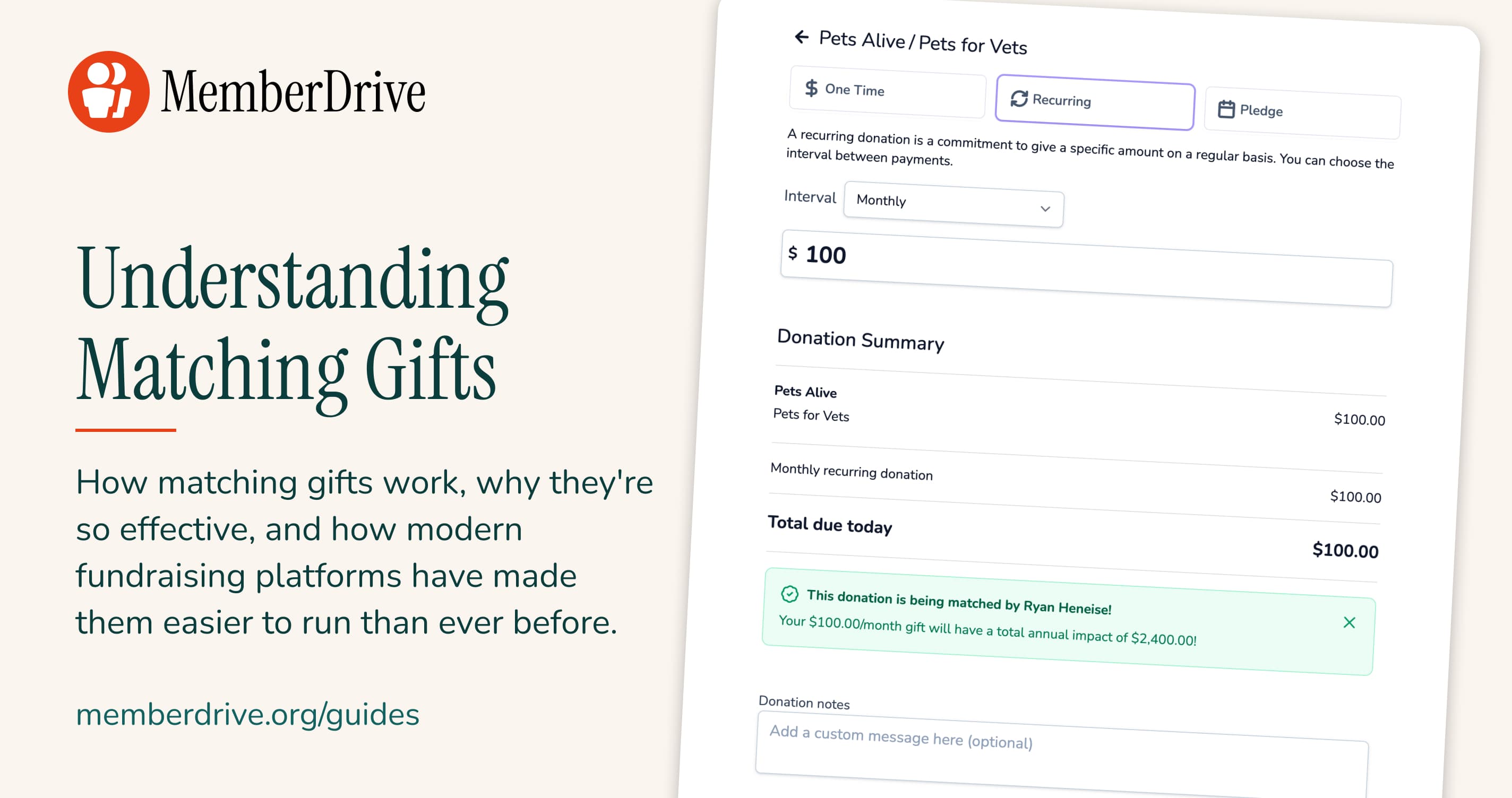
For time-bound matching gifts, the checkout process becomes even more seamless. The platform automatically selects the best available match for each donation, eliminating any friction from the donor experience. Donors see a confirmation message: This donation is being matched by [Lead Donor Name]!
The system handles the allocation behind the scenes, choosing the optimal match based on remaining capacity and other factors.
Impact Calculation Across Gift Types
Matching gifts apply to more than just one-time donations. Modern platforms calculate total impact based on the full commitment value:
One-time gifts are matched based on the payment amount. A $500 gift with a 1:1 match generates $1,000 in total impact.
Recurring donations are matched based on their annualized value. A $100/month recurring gift represents $1,200 in annual commitment. With a 1:1 match, this creates $2,400 in total impact. This recognizes the long-term value of recurring supporters.
Pledges are matched based on the full pledge amount, not just individual installment payments. A $1,000 pledge with a 1:1 match generates $2,000 in total impact immediately, even though the donor may pay in installments over time.
This comprehensive approach ensures that matching gifts incentivize all types of giving, not just one-time donations.
Completion and Invoicing
When a matching gift reaches its maximum commitment or its time window closes, the organization generates an invoice for the lead donor covering the actual matched amount. The lead donor pays this invoice through the standard payment flow.
Throughout the process, automated notifications keep everyone informed:
- Lead donors receive emails for each donation matched
- Weekly summaries provide activity overviews
- Organization managers are alerted when matches are created
- All donors see matching details in their receipts
The lead donor maintains a dashboard view of their matching gift, showing progress, recent donors, and total impact generated. This visibility often deepens their engagement with the organization and sets the stage for future leadership giving.
Time-Bound Matching: Creating Urgency Automatically
One of the most powerful aspects of modern matching gift functionality is time-bound automatic matching. Instead of requiring donors to manually select a match during checkout, organizations can configure matches that automatically apply to all eligible donations during a specific window.
Here's how it works: A lead donor enables the Automatically match donations during this period
option and sets start and end dates. During this window, every donation to the campaign is automatically matched according to the specified ratio—donors don't need to take any extra steps.
The platform uses a smart selection algorithm to optimize match allocation. When multiple matching gifts are available, it selects the best fit based on remaining capacity. If several matches can fully accommodate a donation, it chooses the one with the tightest fit. If no single match can fully cover the donation, it selects the one with the most remaining capacity.
Donors always have the option to opt out if they don't want their gift matched for any reason. This respects donor autonomy while making the default experience as frictionless as possible.
Time-bound matching is particularly effective for:
Fundraising events: A matching gift that runs during a gala or dinner creates real-time urgency as attendees see the match capacity decreasing throughout the evening.
Year-end campaigns: Matches running through December 31st leverage natural giving season momentum while providing a clear deadline.
Emergency response: Time-limited matches for urgent needs create immediate action without requiring ongoing administrative attention. For how aid groups prepare an emergency match before a hurricane or earthquake, see fundraising for international aid organizations.
Real-World Use Case: Chesterton Academy of Tyler
To understand how matching gifts work in practice, consider the experience of Chesterton Academy of Tyler (CAT), a classical Christian school preparing for their annual fundraising gala.
The gala, expected to raise over $200,000, follows the Perfect Vision Dinner
model—a structured fundraising dinner where attendees hear the school's vision and are invited to support it. For CAT, matching gifts became central to their strategy.
Several lead donors committed matching gifts for the event. Rather than simply donating directly, these major supporters agreed to match contributions from other attendees during the gala. The school promoted these matches throughout the evening, with real-time progress displayed for attendees to see.
The psychology here is powerful. An attendee considering a $250 gift knows that during the match window, their contribution generates $750 in total impact (at a 2:1 match ratio). This knowledge often prompts donors to increase their gift size or give when they might have hesitated.
The matching gift structure also creates a natural narrative for the evening. As the match capacity fills, the energy in the room builds. Donors see their collective impact growing in real time. The lead donors, watching their commitment multiply into substantial campaign support, experience the satisfaction of leveraged philanthropy.
For schools and organizations running fundraising dinners, capital campaigns, or major gift initiatives, this pattern—lead donor commitments matched by broader supporter contributions—has become a proven formula for success.
Why Matching Gifts Work: The Psychology
The effectiveness of matching gifts isn't accidental. Several psychological principles make them particularly powerful fundraising tools.
Reciprocity and social proof play major roles. When donors see that a lead donor has already committed significant funds, they perceive the campaign as credible and worthwhile. The lead donor's commitment signals that the cause is worthy of major investment, making other donors more comfortable contributing.
Loss aversion kicks in with time-bound matches. When donors see that a matching opportunity will expire—either by time or by reaching capacity—they're motivated to act now rather than risk missing the multiplier effect. The match creates a sense of scarcity that drives immediate action.
Tangible impact becomes clear and calculable. Instead of abstract promises about what donations will accomplish, matching gifts provide concrete math: Your $100 becomes $300.
This specificity helps donors visualize their impact and feel good about their contribution.
Momentum builds socially. As the progress bar fills and recent donors are displayed, potential contributors see that others are already participating. This social proof reduces perceived risk and encourages joining the crowd.
Lead donor engagement deepens. For major donors, matching gifts offer a way to maximize their impact beyond the face value of their gift. A $10,000 matching commitment might generate $30,000 in total campaign support—triple the effect of a straightforward $10,000 donation. This leveraged impact often increases donor satisfaction and sets up future giving.
Matching Gifts vs. Corporate Matching Programs
It's worth clarifying the distinction between the donor-initiated matching gifts we've been discussing and corporate matching programs, as the terminology overlaps but the mechanics differ significantly.
Corporate matching programs are employer-based philanthropy initiatives. When a donor works for a company with a matching program, they can submit their charitable donation to their employer, who then matches it according to company policy (typically 1:1, though ratios vary). The match comes from the company, not from an individual lead donor, and usually requires the employee to initiate the process through their company's system.
These programs are valuable—an estimated $4–$7 billion in matching gift funds go unclaimed annually due to lack of awareness—but they serve a different purpose than donor-initiated matching gifts.
Donor-initiated matching gifts, the focus of this article, are campaign-level commitments made by individual major donors. They're strategically planned as part of a fundraising campaign, not initiated by individual donors after the fact. They create immediate multiplier effects during specific time windows and are promoted proactively as part of campaign messaging.
Both types of matching are valuable, but donor-initiated matching gifts offer organizations more control over timing, messaging, and campaign integration.
The Competitive Landscape: Who Offers Native Matching Gifts?
Despite the proven effectiveness of matching gifts, surprisingly few fundraising platforms offer native matching gift functionality. Most platforms either lack the feature entirely or require third-party integrations that add cost and complexity.
Among major platforms, native matching gift engines are rare. Some platforms offer matching gifts
that are actually employer-match discovery tools—connecting donors to corporate matching programs rather than enabling campaign-level matching. Others require paid add-ons or third-party integrations to achieve basic matching functionality.
This gap in the market matters because organizations that want to run matching gift campaigns often find themselves cobbling together manual processes: tracking in spreadsheets, sending individual invoices, and hoping they don't make errors in their calculations. The administrative burden discourages many organizations from using matching gifts at all, even though they know the strategy works.
When evaluating fundraising platforms, organizations should ask: Does this platform support donor-initiated matching gifts natively? Can lead donors create matches with custom multipliers? Is there automatic matching during time windows? How does invoicing work? The answers to these questions can mean the difference between a matching gift program that runs smoothly and one that creates more work than it's worth.
Best Practices for Running Matching Gift Campaigns
Based on the patterns that work for organizations using matching gifts effectively, several best practices emerge:
Start with the lead donor relationship. Matching gifts work best when the lead donor is genuinely excited about multiplying their impact. Frame the conversation around leverage: Your $10,000 could generate $30,000 in total support.
This appeals to major donors' desire to maximize their philanthropic impact.
Match the ratio to the context. A 1:1 match works well for most campaigns because it's easy to communicate: Double your impact.
Higher ratios (2:1, 3:1) create exceptional urgency but require lead donors with greater capacity. Consider the campaign context—emergency appeals might warrant higher ratios, while annual funds often do well with 1:1.
Set clear time windows. Open-ended matches can drag on indefinitely, losing their urgency. Time-bound matches create natural deadlines that drive action. For fundraising events, set the match to run just during the event. For year-end campaigns, align with calendar-year deadlines.
Promote the match prominently. Donors need to know the match exists. Feature it on campaign pages, in email appeals, and during events. The progress bar showing remaining capacity is one of your most powerful marketing tools—use it.
Consider anonymous lead donors. Some lead donors prefer to remain anonymous while still having their matching gift promoted. This is entirely valid and can work well—the match is still real, and donors still see their impact multiplied, even if they don't know who's providing the match.
Invoice promptly when matches complete. When a matching gift reaches its limit or its time window closes, generate the lead donor's invoice quickly. They've already fulfilled their commitment by generating the matched donations; prompt invoicing respects their time and closes the loop efficiently.
Track and report impact. After a matching gift campaign concludes, report back to both the lead donor and participating donors on the total impact generated. Your $5,000 match generated $15,000 in total support from 47 donors
tells a compelling story and sets up future matching opportunities.
Conclusion
Matching gifts represent one of the most powerful tools in modern fundraising. They transform a single major gift into a campaign-wide catalyst, create urgency and social proof, and give every participating donor a larger sense of impact.
The key to successful matching gift programs is removing friction—both for lead donors who create the matches and for participating donors who want their contributions multiplied. When the administrative complexity is handled automatically, organizations can focus on what matters: building relationships with lead donors, promoting the match effectively, and watching their campaigns exceed expectations.
For organizations running capital campaigns, fundraising dinners, year-end appeals, or any initiative where donor motivation matters, matching gifts offer a proven strategy for multiplying impact. The question isn't whether matching gifts work—the research and real-world results clearly show they do. The question is whether your fundraising platform makes them easy enough to run that you'll actually use them.
When you can turn one major gift into a community-wide fundraising catalyst with just a few clicks, the decision becomes simple. Matching gifts don't just raise more money—they engage donors more deeply, create memorable campaign moments, and help major donors see their impact multiply in real time.
That's a fundraising strategy worth implementing.
Key Messages Summary
- Matching gifts are donor-initiated commitments, distinct from corporate employer-matching programs
- Impact multipliers of 1:1 (double), 2:1 (triple), or 3:1 (quadruple) give donors concrete reasons to give more
- Time-bound matching creates urgency without high-pressure tactics
- Lead donors can be named or anonymous based on their preference
- Automatic invoicing and tracking eliminate administrative burden
- Real-world examples like Chesterton Academy demonstrate matching gifts' effectiveness at fundraising events
- Native matching gift functionality remains rare among fundraising platforms, making it a key differentiator for organizations that prioritize this proven strategy